



So you have a van. Now where do you actually take it? Everyone and their cousin has a national park bucket list. Yellowstone, Zion, the Grand Canyon. They’re all incredible, and they deserve every bit of hype they get. But if you only chase the famous names, you’re missing out on some genuinely special underrated national parks, and you’re doing it in a van that was built to get you off the beaten path.
In this post, I’m highlighting a handful of parks I consider underrated. Not because they aren’t worth your time, but because they get overlooked in favor of their flashier neighbors. I am ranking underrated through a lens of less popular, but exceeds expectations.
Before we dive in, a quick word on being a responsible traveler. Practice Leave No Trace. Take nothing but pictures, leave nothing but footprints, kill nothing but time. Park and camp in designated areas only. Apps like iOverlander and Hipcamp make it easy to find legit spots. The parks stay beautiful because people respect them. Let’s continue to protect our lands!
Okay, let’s get into it.
Pinnacles National Park (California)
California has nine national parks, and when people plan a trip there, they’re thinking Yosemite, Death Valley, Redwood, or Joshua Tree. Pinnacles doesn’t always make the list since it’s notoriously an underrated national park, which is wild, because it’s got a story like nothing else in the state.
Pinnacles started as a national monument back in 1908. It wasn’t redesignated as a full national park until 2013, making it the newest national park in California. The rock formations that give the park its name actually formed 23 million years ago from a volcanic field 195 miles away, near present day Lancaster. Tectonic forces along the San Andreas Fault slowly dragged that volcanic rock northwest to where it sits today. That’s not something you can say about most parks.
Once you’re there, you’ve got over 32 miles of trails to explore, including the Bear Gulch and Balconies Cave Trails, which drop you into pitch black talus caves formed by rockfall. And if you’re into wildlife, Pinnacles is home to over 400 species of bees (one of the most bee-diverse spots on earth) and a California condor reintroduction program that’s been running since 2003. Spot one of those massive birds overhead and you’ll understand why people are so protective of this place.
Theodore Roosevelt National Park (North Dakota)
I’ll be honest, western North Dakota is not on most people’s travel radar. But it should be.
Theodore Roosevelt first came to the badlands to hunt bison in 1883 and fell hard for the rugged, wide open landscape. After losing both his wife and mother on the same day in 1884, he came back here to grieve and eventually built a second ranch. That personal history is a big part of why the park exists today, officially established in 1978.
The badlands themselves are worth the trip on their own. You’ve got around 100 miles of hiking and horse trails across the park’s three units. Plus, you have the Maah Daah Hey Trail, which stretches more than 140 miles and connects all three sections. Bison, once hunted nearly to extinction in the area, were reintroduced here in 1956 and 1962 and now roam in the hundreds. Add in elk, bighorn sheep, wild horses, and prairie dogs, and you’ve got a landscape that feels like the Great Plains never stopped being wild.
Indiana Dunes National Park (Indiana)
Indiana Dunes gets overshadowed by other “sandy” national parks like Great Sand Dunes and Death Valley. And I get it, the dunes here aren’t as vast. But experiencing Lake Michigan from this park is nothing short of spectacular – and that’s why. I believe it deserves to be on this underrated national parks list. It feels like a day at the beach without the salt, and it’s a quick trip if you’re near Chicago.
What people don’t realize is that Indiana Dunes is one of the most biodiverse national parks in the country, ranked fifth in the nation as of 2021, right behind Yosemite. There are over 350 bird species here, and the park is actually considered the birthplace of the science of ecology. A University of Chicago professor named Henry Chandler Cowles studied ecological succession in these dunes, and that research helped launch an entire field of study. The park itself has a long road to get here too. The push to protect this land started in 1899, the state park opened in 1926, and it wasn’t until 2019 that it officially became a national park.
For hiking, you’ve got about 50 miles of trails, including the Dune Succession Trail, which climbs 250 stairs and rewards you with a view of both Lake Michigan and the Chicago skyline.
Isle Royale National Park (Michigan)
Isle Royale is less popular for one simple reason: it’s hard to get to. There are no roads in, only boats and seaplanes, which naturally keeps the crowds away. But here’s the fun fact that always surprises people: Isle Royale is actually the most revisited national park in the country. Once you go, you tend to go back.
Established in 1940, the park sits in Lake Superior, made up of the main island plus more than 400 smaller ones. It’s the fifth largest lake island in the world. Once you’re there, you’ve got 165 miles of hiking trails, including the Greenstone Ridge Trail, a 42 mile classic that most backpackers tackle over four or five days.
Isle Royale is also home to one of the most famous wildlife studies on the planet. The moose and wolf population here has been tracked since 1958, making it the longest continuous predator-prey study of any ecosystem anywhere. Watching that balance play out between the two species is part of what makes this island so special.
North Cascades National Park (Washington)
Mount Rainier and Olympic National Park often overshadow North Cascades, and it’s one of the least visited parks on this list. Most people treat it as a quick pop in and out on their way somewhere else, but you can absolutely spend real time here.
The numbers alone are worth mentioning. North Cascades is home to more than 300 glaciers. It’s the largest glacier system in the mainland United States. This includes Boston Glacier, the biggest of the bunch at 2.7 square miles. The elevation gain across the park (nearly 9,000 feet) creates one of the widest ranges of biodiversity found in any U.S. national park, with over 1,630 documented species and counting.
Nearly 400 miles of trails wind through the park. This includes the Cascade Pass Trail, a roughly 12 mile round trip that climbs through forest before opening up into sweeping alpine views. Keep an eye out for black bears, bald eagles, and if you’re lucky and high enough up, wolverines and pikas.
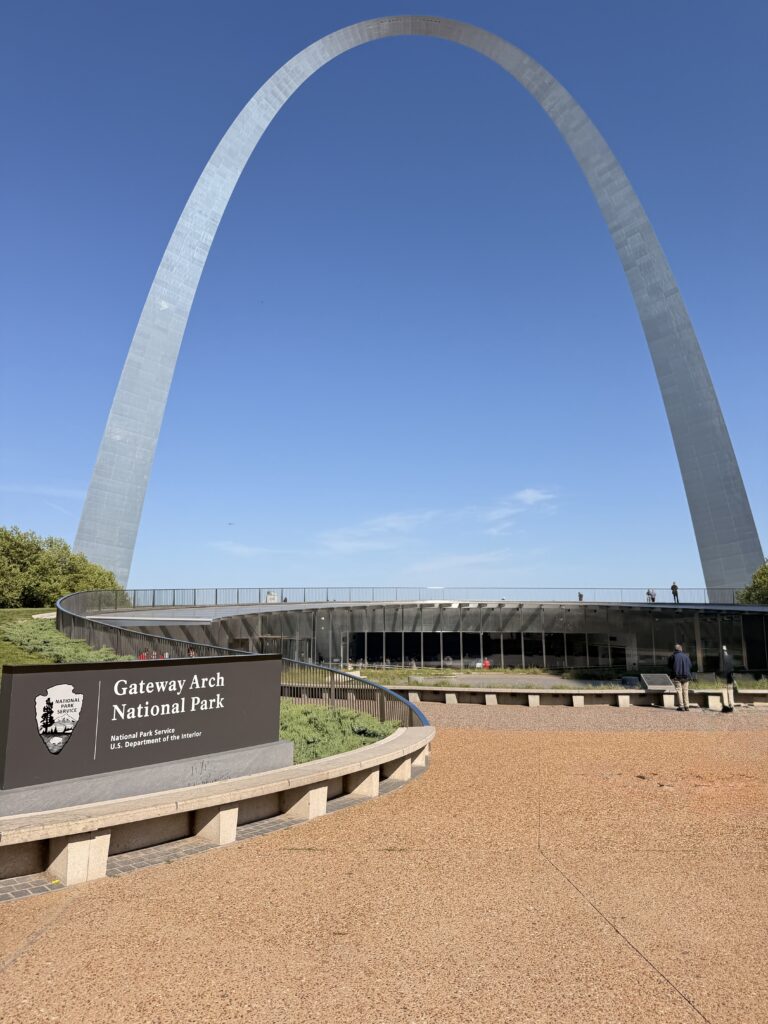
Gateway Arch National Park (Missouri)
This one is different from everything else on this list, and I know some die hard national parkers skip it entirely because it’s not exactly a “natural” park. But hear me out, because Gateway Arch might be the most accessible park you’ll ever visit.
Sitting in the heart of downtown Saint Louis, the Arch is genuinely magnificent to see in person. Eero Saarinen and engineer Hannskarl Bandel designed the park, built between 1963 and 1965. It stands 630 feet tall, making it the tallest memorial in the country. What started as a national memorial in 1935, honoring westward expansion, was eventually redesignated as a full national park.
You can easily make this a day trip. Take the tram ride to the top (it runs through a series of small pod-like cars) for a view that stretches 30 miles in every direction. Spend some time in the museum below, as well. This was completely rebuilt in 2018 and tells the story of St. Louis and westward expansion in a way that actually holds your attention. Then wander the grounds outside before you head back to the van.
Get out there to these 6 underrated national parks
These parks might not show up on the postcards next to Yosemite or Yellowstone, and that’s exactly the point. Underrated doesn’t mean less than. It just means fewer people have caught on yet.
Take the road less traveled; some of the best trips aren’t the ones everyone else is already taking.